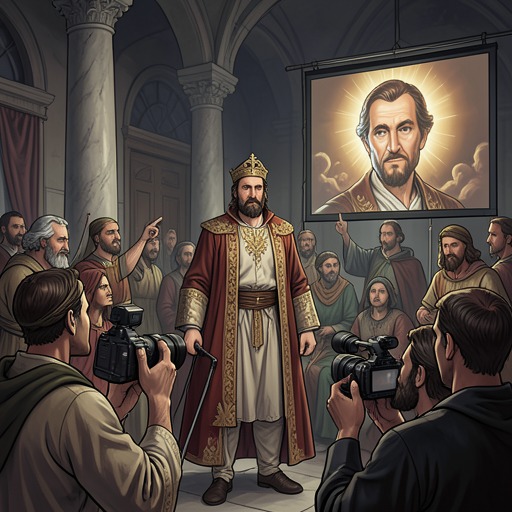
Rama Studios
The Satanic VersesRama Studios is the Bombay film lot that turns Gibreel Farishta into a star and then makes his absence visible. Its sound stages and painted scenery frame both the industrial choreography of his career and the breakdown that follows when he vanishes: the chair that once carried him between productions is left behind, and the studio’s machinery of fame cannot explain where its central performer has gone.
Lot, Stages, and Production Rhythm
On the D. W. Rama lot, Gibreel’s work was organized around speed and simultaneity. He could make as many as eleven films at once, and four trusted wheelchair attendants moved him from set to set so that he could conserve his energy. Their routes followed a system of slashes, circles, and dots that Gibreel remembered from Bombay’s lunch-runners. After each take he returned to the chair and was rushed to the next set for a new costume, make-up, and lines. The routine gave the studio a strikingly literal image of star production: one performer moved through multiple roles by a coordinated team.
After his illness, Gibreel returned to work at a reduced pace, taking on seven pictures at a time. Then, without explanation, he stopped appearing. The wheelchair stood empty among silent sound stages, and the painted sets were exposed as theatrical fabrications. When film executives demanded explanations, the attendants offered excuses for the missing star; the studio fired them one by one. A chair was eventually abandoned beneath painted coconut palms beside a sawdust beach, a residue of the production world that had once kept Gibreel in constant motion.
Theological Films and Stardom
The studio’s productions helped establish Gibreel’s public identity through films based on sacred stories. When D. W. Rama scheduled a picture about Ganesh, established stars declined the part because it required performing inside an elephant’s head. Gibreel accepted, and Ganpati Baba became his first hit. He then played the elephant-headed god in six films before taking on the long tail of Hanuman in an adventure series. His unusual willingness to inhabit elaborate transformations became the opening to a career in which costume, role, and celebrity fused.
The broader success of the theological films made Rama Studios a source of images that reached far beyond its stages. Gibreel played Krishna and Gautama, among other divine figures, and his screen presence crossed religious boundaries without, the narration observes, giving offence. For many fans, the distinction between the actor and the deities he portrayed had largely disappeared. His screen face could consequently seem more than human, even as the films remained products of a studio lot and its staged worlds.
Absence and the Studio’s Failed Search
Gibreel’s disappearance turned the studio’s production routine into a public and commercial crisis. Producers feared the loss of the one name that could still promise a major hit amid declining audiences and competition from television. Search efforts extended across the city and harbour, but brought no answer. On one of Rama Studios’ seven inactive stages, Miss Pimple Billimoria discovered that her major scene would not take place and offered a bitter farewell before the sound recordists and electricians. Her abandoned opportunity registered the practical cost of the missing star: a production had been prepared around him, and could not proceed as planned.
The absence continued beyond the lot. Gibreel’s likenesses on Bombay billboards, magazine covers, and cinema screens began to decay, fade, or malfunction, as if the star’s disappearance were undoing the images through which the public had known him. The studio’s empty chair and silent sets belong to this larger collapse of visibility: the institution could stage divine appearances, but it could not control the departure of the actor on whom those appearances depended.
From Studio Image to Public Spectacle
Rama Studios belongs to the beginning of Gibreel’s screen career, while later episodes relocate his performances to other stages. At Earls Court, he appears in an angel costume amid a spectacle designed by his producer; after the ensuing riot, conflicting accounts circulate about how he vanished. The rumor that he had levitated away spread among London’s Asian population, where toy haloes and rubber horns became signs associated with the competing interpretations of his appearance. That later public uncertainty echoes the studio’s earlier predicament: Gibreel’s image could be manufactured, repeated, and sold, but his actual whereabouts remained beyond the institutions trying to explain him.